Monday, January 22, 2024

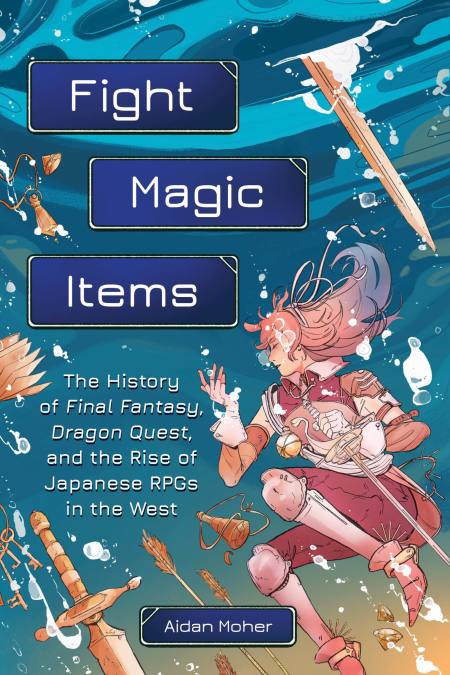
Non-Fiction Book Review: Fight, Magic, Items by Aidan Moher


Fight, Magic, Items is a non-fiction history book detailing the history of a specific sub-genre of video game: the JRPG, or Japanese Role Playing Game. This involves Moher going back to the genre's roots in Western video/computer games and fantasy and science fiction media that influenced the genre's first Japanese creators to make their games for the NES and other consoles, before the genre began to take off on its own. The book spends a lot of time dealing with the Final Fantasy and Dragon Quest/Warrior series, as some of the more major JRPG titles, and the book especially is interested in Western reactions to JRPGs and the struggles it has been sometimes for JRPGs to be localized and brought over to North America and Europe.

As a huge fan of JRPGs, although one who came into the genre later than Moher (my first JRPG came on the PS1 in Legend of Legaia, with my first completed JRPG being Final Fantasy X), I was really interested in the subject, and as I'll detail below, Moher does a really good job going through a chronological and not chronological narrative of how they came about and how the genre has evolved and is still evolving. There's a bunch of things Moher doesn't get into that I wish he had, but Fight, Magic Items is still a really interesting history for those who are fans of the genre.

Note: I read this in audiobook form. This can be a little awkward as I believe the print book has frequent little inserts in which the book quickly describes various JRPG titles that come up in the narrative which the book doesn't have time to go in depth about. In the audiobook, these inserts are dealt with by the audiobook reader interrupting the narrative to narrate the inserts, and if you're not aware of what's going on and paying attention it can be a bit confusing when a long bit of narration about one part of JRPG history - and a specific game in general - is interrupted for 30 seconds for a brief description of another game...only for the narrative to just go back to the first game. The reader is good mind you, but I suspect between pictures and these inserts you lose something not reading this book in print.

Thursday, January 18, 2024

SciFi/Fantasy Book Review: The Archive Undying by Emma Mieko Candon


 The Archive Undying is the first in a new SciFi trilogy by author Emma Mieko Candon. Candon was the writer of the tie-in novel Star Wars Visions: Ronin, which expounded upon an anime Star Wars short that was produced by a Japanese Animation studio and did so in a way that was really really good. That novel took what was a short that did not need any further expansion and made it its own story with its own tremendous characters and themes and really got me excited for seeing Candon's future work. And so here we have The Archive Undying, a book described as dealing with "war machines and AI gods run amok" by its marketing campaign and wow was I excited to get my hands on this one.

That said, while the Archive Undying does have giant mecha, war machines, and AI gods gone mad, the story is a lot more human and personal. The story focuses on a protagonist named Sunai who was raised seemingly to die by the AI god who ruled his city...and who in the process of dying transformed Sunai into a man who cannot die or even age. And the story focuses upon Sunai as he deals with his past with that AI god, as well as two friends he has met in the years since who also have ties to that god, and most significantly with his attraction to and sudden relationship with an engineer Veyadi who may be involved with that god's unholy resurrection by a foreign superpower. The story is incredibly chaotic and kind of confusing, as its perspective changes frequently, with the book using first, second, and third person narratives at various points, and honestly after reading it I kind of still wonder what exactly I read. And yet in some ways it works as it showcases how Sunai and Veyadi struggle with their pasts, their self-worths, and what it means for them to possible have a future in some body or another.

I will try to explain....poorly....after the jump:

Tuesday, January 16, 2024

SciFi/Fantasy Book Review: The Game of 100 Candles by Marie Brennan


The Game of 100 Candles is a tie-in novel written by fantasy author Marie Brennan (The Memoirs of Lady Trent, The Rook and Rose Trilogy with Alyc Helms) which takes place in the Legend of the Five Rings (L5R) roleplaying/card game universe.  It's actually the second book in a trilogy which began with The Night Parade of 100 Demons (Reviewed Here) a few years ago.  The book really requires no prior knowledge of the L5R world and can even possibly be read without reading the prior novel, but I would highly recommend that you read the Night Parade first, as much of this book is built on the foundation of that one, and that book was really good.  

The Night Parade dealt with two (male) samurai - Dragon clan Samurai/Priest Ryōtora and Phoenix clan Samurai/Scholar Sekken - who, carrying secrets of their own, were investigating supernatural Yokai attacks in a small village...and who in the process fell in love with one another.  The Game of 100 Candles follows up on the aftermath of those events as a year has passed since Ryōtora and Sekken have seen each other and the two of them now have to deal with inter-clan politics, issues of bloodline inheritance, and family complications that stand in the way of any potential official match between them...and that's before people start falling into a supernatural sleep in a way that makes it seem like Ryōtora's Dragon clan is at fault.  

The result is a story that is in the end incredibly charming as its two protagonist struggle with both their new supernatural problem and the complications involved in their love for one another, which features a number of delightful new characters (Sekken's family in particular) and manages to make an awful lot of frustrating pining and secret-keeping worth it in the end.  A very recommended second novel and I can't wait for the third.  

Spoilers for Book 1 are below:


Wednesday, January 10, 2024

SciFi/Fantasy Book Review: Where Peace is Lost by Valerie Valdes


Where Peace is Lost is the fourth novel by author Valerie Valdes, who was previously known for her space opera "Chilling Effect" trilogy. That trilogy, which I loved, was an incredibly humorous space opera whose setting cribbed in large part from Mass Effect but also featured a billion other geek references, as it told the story of the reckless but incredibly fun Captain Eva Innocente and the crew of the La Sirena Negra as they get caught in the middle of galactic-level conflicts. It was an incredibly fun trilogy that only got better with each book, so I was super eager to hear about and try Valdes' follow up (and had my library pre-order it).

Where Peace is Lost is however a very different book than Valdes' first trilogy - not only is it stand-alone, but the story is a far more introspective science fantasy novel without the focus on humor. As Valdes' admitted in an interview, the story is very much inspired by the idea of Obi-Wan or another retired Jedi hiding away as the Evil Empire triumphed, and how they would cope in their new home as evil continued to cause damage both elsewhere...and on their new adoptive home. But while the story is very different in tone from Valdes' other works, Where Peace is Lost is still really really good, and well worth your time, as it uses this concept to explore a couple of fascinating characters and some really interesting themes about hiding, denial, grief, and what is and is not a worthy sacrifice.

Monday, January 8, 2024

SciFi/Fantasy Book Review: System Collapse by Martha Wells


Full Disclosure: This book was read as an e-ARC (Advance Reader Copy) obtained via Netgalley from the publisher in advance of the book's release on November 14, 2023 in exchange for a potential review. I give my word that this did not affect my review in any way - if I felt conflicted in any way, I would simply have declined to review the book.

System Collapse is the latest work in Martha Wells' "The Murderbot Diaries" series, her award winning series about the construct SecUnit (an artificial being created out of biological and machine parts) who goes by "Murderbot" internally despite being an introverted anxious being who would rather watch media/soap-operas rather than do anything else.  If you're somehow unaware of Murderbot, despite large popularity and awards, well, its protagonist is incredibly lovable as it tries to stay out of trouble despite hacking itself to freedom...and despite it falling in with a group of humans it comes to care about and has to keep from getting themselves killed from time to time.  The story began with a quarter of novellas (beginning with All Systems Red), expanded to a full length novel (Network Effect), and then continued with a prequel novella last year (Fugitive Telemetry). 

System Collapse is I guess a short novel - it's almost in between the page length of Network Effect and the Novellas, at something like 250 pages - and it's a direct sequel largely to Network Effect.  And it's fun in the way Murderbot works tend to be, as Murderbot deals with its old Preservation humans and its new ART-crew humans (plus a spinoff of ART) as they try to convince some separatist colonists to trust them over the ambassadors for a dangerous corporation.  At the same time, the book's in between length seems to have come at a cost, as the book also deals with a plot of Murderbot dealing with traumatic flashbacks that may or may not be accurate and kind of fumbles that plotline just a little bit.  There's enough interesting here that I rather enjoyed this, and Wells' prose is always well done, but the in-between length and incomplete trauma plotline make this one one of my lower ranked works in this really great series. 

Thursday, January 4, 2024

SciFi/Fantasy Video Game Review: The Legend of Heroes: Trails Into Reverie


Reviewing a Video Game is not something I normally do on this blog, although I've done it for a few games, most notably those in the Trails series. But after spending two months (140+ hours) basically playing this game instead of reading, I really feel like I want to give a bit more of an effort into my review of this game, even if I will be retreading some ideas that have been covered in other pieces.

Trails Into Reverie is the 10th game in Falhom's "Trails" ("Kiseki" in Japan) series of Japanese Role Playing Games. Unlike a lot of other long running series of video games or RPGs, like say Final Fantasy, the Trails series does not try to keep each game independent of each other so that newcomers can play them without having to play earlier games first. Instead, the series is like a long running steampunk-ish fantasy book series, with each game building upon the past installments such that new readers who start in the middle are going to miss at least a little bit - if not a lot - if they don't go back and read what came before. That's not to say there aren't on-ramps into the series other than the beginning; like a long running series, there are different arcs in the series featuring different countries in the setting, so if you start at the beginning of an arc you can probably get by just fine and enjoy....but events and characters of prior arcs will get involved in new ones not before long. As someone who has played all 9 prior games to this one - and even played the two of those 9 games that weren't localized in the US until last year well before that due to a translation patch - I guess I'd kind of be considered a major fan of the series, so this isn't quite a dispassionate review here, and I'm not going to take too much time to try to get people up to speed on the story in this review either...I don't think it's necessary for my judgment of this game or my judgment as to whether you should be interested in the series in general based upon this review (there won't really be spoilers here either in specifics in this review).

Like many long running fiction series, particularly in science fiction, fantasy or romance, a key element involved in Trails keeping me interested 10 games in are the characters and their development. The plotting in the games has runned from really great romantic fantasy (the first two Trails in the Sky games) to solid geopolitical thriller with questions about whether Omelas-like-suffering might be worth utopia (the Crossbell Games, Trails from Zero/Trails to Azure) to complete and utter mess, sometimes in infuriating ways (the Trails of Cold Steel Games). But each game in the series develops major characters - many old, some new depending on the game - and develops so so so so so many side characters who aren't really important such that you can't help but loving and wanting to spend time with almost everyone, even if there are some characters you likely cannot stand. So even after the 9th game in the series, Trails of Cold Steel 4, was a bit of a disaster in my opinion even in the character development department (particularly in how the game handled a major antagonist from the last 7 games), well, I couldn't help but want to plaly Trails Into Reverie as soon as it got over here like 3 years later, just to spend time with the characters again. And Trails from Reverie is a game built upon feeding that desire - this is a game that, even in introducing a new plotline and new small party of characters for a 1/3 of it, is really built upon giving you as much time as you could possibly want with almost every major character of the last SEVEN games and beyond. It's a fanservice game in the non-sexual meaning (although there is some of that too because sigh, it's a JRPG) to the extreme, intent on giving you more more and more - more character interaction, more gameplay of all the main systems and side mini games, more utterly bonkers possible ways to break the prior games' already broken combat systems. And the game is so so good at doing that and is simply incredibly addictive.

Tuesday, November 7, 2023

Fantasy Novella Review: Spear by Nicola Griffith


Spear is a Nebula Nominated Novella by author Nicola Griffith. The Novella, which has won praise and nominations for multiple awards, is a queer adaptation of Arthurian and Welsh (Fae) Myth featuring a genderflipped version of the knight Perceval named Peretur. I enjoy some Adaptations of Arthurian Myth but don't really seek them out, so I skipped out on Spear when it first came out...but the sheer amount of acclaim the novella received made it pretty much impossible for me to skip it for too much longer.

And well Spear is pretty damn deserving of its acclaim. The story features Peretur as its protagonist as she starts out being raised alone in a cave magically warded by her mother Elen - who fears Peretur's fae father who once enchanted Elen - and follows Peretur as she sets out against her Mother's wishes to explore humanity and to join the companions of Artos who she sees defend the land. Written in really gorgeous prose, the story sees Peretur grow up, bind her breasts to appear as a boy, grow interested in and have experiences with girls, and - armed with her trusty spear - come into contact with Artos' companions and learn the truth behind both them and her own origins...and how power can so easily corrupt. It's a really effective story that is very easy to recommend.