Sunday, December 20, 2015

Retro Review: The Thrawn Trilogy Part 2: Dark Force Rising

Tonight it's time for our second retro review of the original Star Wars sequels, The Thrawn Trilogy - Book 2: Dark Force Rising.  Tomorrow we'll complete this series with a review of The Last Command and a review and analysis of The Force Awakens.  But for now: Dark Force Rising.  


DFR benefits from having the groundwork laid by Heir to the Empire quite a bit - every existing player in the book except 2 (Garm Bel Iblis and Niles Ferrier) are from the prior book, while most of the plot of this book is directly set up by the prior book's cliffhangers as well.  The plot of this book features the following storylines:

1.  Leia goes off to the homeworld of the Noghri, where she tries to make amends for the destruction of their world and to convince them the Empire is simply using them;
2.  Luke heads off to Jomark to meet Joruus C'baoth, where he tries to see if this is a Jedi Master he can learn from, and if not, if he's someone Luke can help.
3.  Mara Jade begins to feel the force return to her and at the same time tries to help Karrde evade Thrawn's grasp, eventually leading to her needing Luke's help to rescue Karrde from Thrawn.
4.  Han and Lando go out to try and find incriminating evidence against Bothan Borsk Fey'yla and to exculpate Admiral Ackbar from the treason charges against him and wind up discovering a forgotten former Rebel General/Senator
5.  The last two plots combine to form the finale, where the main characters attempt to race to a fleet of lost warships which might turn the tide in the battle between the Empire and New Republic.

You'll note that one of those plots, #3, basically has no involvement of our major movie characters whatsoever until the very end (when Luke and Mara team up).  That's the benefit of Heir's setup here - we're interested in both Mara and Karrde's fate from the start, without the need for major characters crossing their paths.  Incidentally, this book would be more logically called "The Force Awakens" for this plotline with Mara than the movie is (more on that tomorrow).  

Most of the rest of these plotlines work as well.  The Noghri plot works really well and is very impactful and Luke's reaction to C'baoth is very believable and really works up how the mad jedi is trying to "train" Luke in a different way than we'd previously seen Vader/Emperor work on turning him to the Dark Side.  

Han and Lando's plotline is a bit more hit or miss.  Garm Bel Iblis would become more of a major character as a master tactician in the Expanded Universe, but here he comes off as whiny - it doesn't help that Mon Mothma's influence really isn't shown that heavily in the movies (one scene in ROTJ!) or Heir. (This problem will extend to The Last Command as well).  The sequence of events that leads them to him is well...very coincidental even for a series such as this, 

And then there's Niles Ferrier, the other major character introduced in this book.  He's just a bad character (along with his Wraith who isn't even named) altogether and basically just a plot device.  So he's a master ship thief but who smokes a distinctive type of Cigar such that Lando and Luke (and presumably others) can identify him basically anywhere by smell?  Really?   Speaking of coincidences, him showing up magically on the next planet Luke and Lando go to a few chapters after meeting them in the opener is something.  Again, he's basically a plot device who leads the characters from point A to point B and this is probably why he'd never be seen in the EU again after The Last Command (yes he dies in that book, but he never appears in books set prior to this trilogy either).  

The other real flaw in the book is the Fey'lya plot is...well, kind of lousy.  A regular flaw of the expanded universe in Star Wars is that non-human races frequently get treated as a group of individuals all of whom share the same traits - in this case, Bothans are treated as sneaky power grubbing aliens.  Fey'lya is the ur-example of that (and alas, he's not alone) and it doesn't help that he's just so comically ineffective at doing anything.  The "speaking into an unexpectedly live mic" strategy that dooms him in the end is cheesy and well, the treason charges of Admiral Ackbar are actually never cleared in this book - it's cleared offpage in between this book and The Last Command (by Talon Karrde's slicer, Ghent).  

Again, these are basically nitpicks.  Most of this book works really well and the finale of the book is definitely earned.  And like Empire, this book functions as a table setter for the trilogy's finale, as the good guys get their butts handed to them and learn the true nature of Thrawn's plan - the Clones.  And the book also sets up Thrawn's fallibility - numerous times he makes the wrong determination from the evidence at hand - due to making false assumptions as part of his thinking process.  And with the Noghri starting to turn against Thrawn, the seeds for the good guys' final triumph are set.  

That said, this would again be really tricky to film.  As I detail above, there are four separate plots going on simultaneously for most of the book, wit the characters all separate in different locations.  In the original trilogy, the split is at most 3-way (ROTJ where Lando is in space, Han & Leia on the planet, Luke on the Death Star), and even there, those plots are related and in the same area.  This split is more like something you'd see on a TV Show, bouncing around between separate plots before everything culminates in the finale.  

On that finale Heir and DFR end with all of their plots converging into a single plotwith seemingly large stakes at risk (of course, Thrawn has basically already won the large stakes before the finale of DFR).  This is of course similar to Eps 4 and 5, which also have all plots converge at the end.  Return of the Jedi does not have all the characters converge in one area at the end, and as we'll see tomorrow, neither does the finale: The Last Command. 

Friday, December 18, 2015

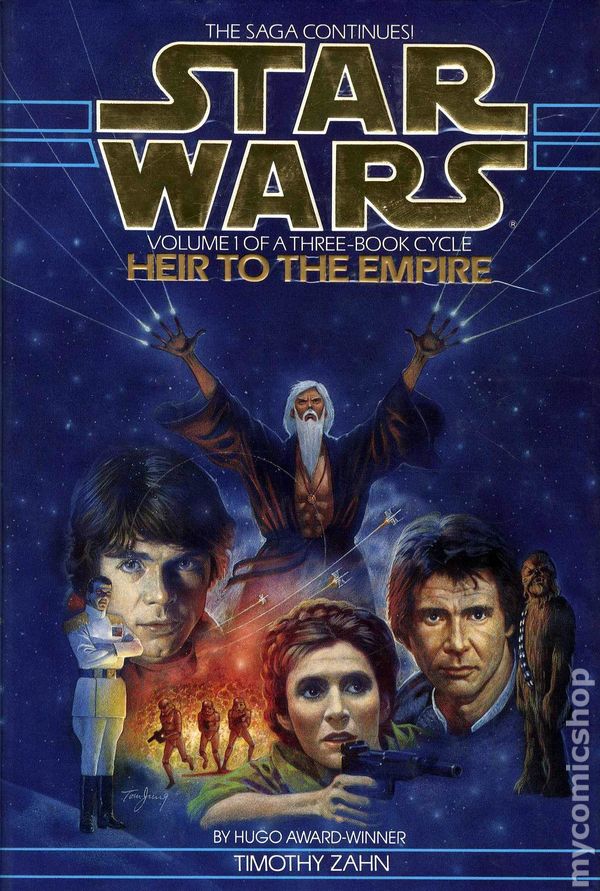
Retro Review: The Thrawn Trilogy Part 1: Heir to the Empire

Disney is releasing their version of Star Wars Episode VII this weekend: Star Wars, The Force Awakens.  I'm excited of course - I've been a star wars fan since elementary school - and have tickets to see it tomorrow.  That said, like a lot of people, I'm a little sad because well - I grew up reading plenty of Star Wars stories set after the original trilogy, some of which I loved (some of which, on the other hand, were garbage).  My online handle actually comes from one of these books (X-Wing: Wraith Squadron to be precise).  With TFA, Disney has declared all of the Expanded Universe non-canon, which is really brutal to those of us who loved these stories.

In fact, three books, and one story really, of the Expanded Universe were often regarded as sort of an unofficial Episodes 7-9: Timothy Zahn's Thrawn Trilogy.  These books essentially started the Expanded Universe and were a huge reason why it became a big deal in the first place, introducing several new characters who would make large impacts in the Star Wars world for years.  As these books are being wiped from canon, I feel like it'd be a fun time to actually reread all three books in the trilogy to see how they hold up and what is being lost.  I may also take a quick look at how adaptable these books actually would've been if Disney had decided to go that route.  

Heir to the Empire


Heir to the Empire skips ahead about 5 years after Return of the Jedi, but jumps right in.  The Rebellion has established the New Republic, and while still fighting the Empire, has it seemingly in retreat.  Leia and Han are married and Leia is pregnant with twins - who seem to be force sensitive.  Luke is a lone Jedi still searching for a way to move forward as the first new Jedi.

But even this intro is getting ahead of itself.  You see, Heir doesn't start with the characters we know and love.  Instead, the first chapter dives straight into the new antagonists (starting of course with a ship in space, because every star wars movie needs to do that), a pair leading the Empire on a new surge:  Captain Pellaeon, who serves basically as our Ishmael  for this side of the story and Grand Admiral Thrawn, the new leader of the Empire.  Thrawn is a tactical genius, whose race (he's a blue skinned alien with red eyes) is the only reason he wasn't deployed against the Rebellion in the movies, who often seems able to predict his enemies' every move.  And his enemies....are our heroes.
The intro to Thrawn is brilliant, showing him using knowledge of an alien race to rout them in a space battle and showing his usage of art-study (!) to analyze the behavior of that species.  This could seem awfully cheesy, but it's really not, and Thrawn is compelling from the start.

The first few chapters also introduce us to the second antagonist of the series: an insane dark jedi master named Joruus C'baoth.  Thrawn recruits C'baoth with the promise of providing him Luke, Leia, and Leia's twins to train such that Thrawn can use C'baoth's abilities to help him restore the Empire (this'll be examined more later).   C'baoth is not nearly as compelling as Thrawn because well...insane overpowered bad guys are insane overpowered bad guys.  They're not particularly new.  Still he works in this story - presenting an evil threat to the Empire's new actions that Thrawn doesn't himself.  Think of him as the Emperor of the original trilogy to Thrawn's Vader - Vader was the compelling antagonist of the trilogy, but the Emperor showcased the true evil that the good guys were facing.

Of course, the book also introduces two new protagonist characters who would also have major influences on the Expanded Universe.  First, Talon Karrde - a super smuggler/information broker who has become the big smuggler chief since Jabba the Hutt was killed, who is trying to manage to make a profit without becoming targetted by either the Republic or the Empire.  Again, this could totally not work (and in some later books, Karrde basically does become just like a mary sue plot device type character so it doesn't), but it really works here.

And then there's Mara Jade.  If there's a character that most EU Star Wars fans will miss, it's Mara Jade.  A strong independent woman, who's force sensitive (and formerly worked as the Emperor's special agent himself), smart, and assured of herself, she's basically Zahn's greatest creation by far.  The only woman in the original trilogy is Leia, and while she has some autonomy and badass moments in the series, she spends a good deal of time being rescued.  Not Mara Jade - she's the rescuer, not the rescuee.   TFA is introducing a new female character as one of the main characters, and Jade gives her a lot to live up to.

I'm this far in and I've basically not talked about the plot of the book at all, which is ridiculous.

Honestly, it's less important than the world building that's done here, introducing the various characters as well as various worlds and species that will pay off later:
Wayland - a hidden planet containing the Emperor's storehouse of secret technologies, such as a cloaking shield (and one other little technology hinted at but not explained here)
Myrkr - a planet the Old Republic Jedi avoided because it houses a species called the Ysalimiri, which suppress the force for a small distance around themselves
The Noghri - a species of aliens used as assassins by Thrawn, who regard the late Darth Vader as their savior.
Borsk Fey'yla - a Bothan councilmember of the New Republic plotting to take over power from Admiral Ackbar no matter what it takes.
Coruscant - the capital planet which actually remains canon thanks to the prequels.

These are big concepts, and this book introduces them all!  It's the next two books where the world building pays off.   But despite the climaxes of this book not involving some big epic battle with an epic victory (the two climaxes involve Luke slicing a few pillars with his lightsaber to collapse a building on top of stormtroopers and the good guys destroying 50 of their own ships that were about to be taken over by Thrawn), the book still works well at setting up the threat of Thrawn and C'baoth, while providing multiple great action sequences.  It really feels cinematic.

Which is not to say adapting the book would be easy.  Whereas the original trilogy tended to stay on certain locations for large sequences of time, this book jumps around a LOT - take a look at where the first few chapters take place
Chapter 1: Thrawn in space in a Star Destroyer
Chapter 2: Luke and Leia on Coruscant, Han on Tattooine
Chapter 3: Karrde and Mara on Myrkr
Chapter 4: Thrawn on Wayland

That's 5 different locations in four chapters!  That's kind of hard to do without losing the audience in film, where you don't have internal dialogue to introduce concepts.

That said, again, the book FEELS cinematic.  None of the battles here are large at all, but they feel epic.  And this is only the beginning.

TOMORROW:  We talk about Dark Force Rising, the second book in the trilogy.  Much more focus on the plot of that one actually.  (Oh and I'll have thoughts on TFA myself).

Tuesday, November 5, 2013

Where Chris Boyle's Shot Quality work can and probably can't be useful.

Chris Boyle has been slowly unveiling the results of his shot quality tracking for Sportsnet over the past few weeks.  Like a lot of smart people, Boyle has recognized an area where the NHL is extremely poor at tracking something in today's NHL hockey games - in this case, where shots on goal are taken from on the ice - and attempted to fix the situation and watch games himself and track where each shot comes from.  Boyle had previously shown that the NHL shot trackers are hopelessly incompetent and this is a pretty nice way to try and get better data.

So Boyle has tracked a ton of hockey games and marked down where shots have come from - and, perhaps even more interestingly, what types of shots these shots were (Clean shots, Shots off of passes, shots off of deflections, and shots off of rebounds).  This is all very cool stuff and can be useful if we have a large enough sample and we apply it in the proper places.

Unfortunately, so far Boyle hasn't quite done that.  After finding the average SV%s of each type of shot, Boyle posted today his results as to several goaltenders, focusing mainly upon James Reimer.  Boyle finds that Reimer's first season's results may have been skewed in Reimer's favor by the sheer # of clean shots Reimer faced.  In other words, Reimer faced low quality shots more often than average, resulting in an inflated SV% that we might expect to drop as Reimer faces higher quality shots in the future.  So far, this is pretty interesting stuff, especially when we're dealing with small goalie sample sizes as a single season.

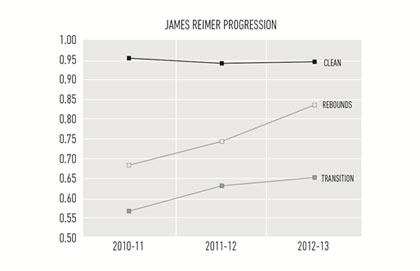
Reimer's season in 2012-2013 was different as per Boyle's findings - Reimer featured a much tougher shot selection, but still had way above average results, particularly against rebound shots.  The money graphic is this one:

According to Boyle, League average rebound SV% (at 5 on 5) is .760.  After two years of being below average at this mark, Reimer actually hit a rebound SV% of .844 in the last 1196 shots.  And here is where Boyle goes way off the deep end:

His clean save percentage remains fairly static, but his rebound and transition rates continue to improve.
All of this could be small-sample magic, but it is consistent in regards to most young goaltenders’ learning curves. The biggest adjustment a goaltender makes during the adjustment period to the NHL is the speed of the game. When overwhelmed by the pace, he is late tracking the puck and will trail the play. When that happens, he must rely on reflex and reaction. That leads him to play with less control and means more of a struggle to anticipate and read the play.

As a young goalie gains experience, he relies less on reflex and reaction saves because he tracks the puck better. This allows him to skate ahead of the play and employ a game plan. Reimer has quieted his game and with that his deflection and rebound save percentages have risen thanks to better positioning.

The Reimer of 2010-11 could not have survived the onslaught of rebound opportunities he faced in ’12-13—he saw twice the rebound opportunities, yet maintained the exact same goal rate.

.....

With a strong start to 2013-14, Reimer’s numbers have climbed to a point where he is not just a reliable NHL starter, but a good one. Even if he remains weak in transition, maintaining a dominant performance when faced with rebound shots will push him above the middle class.
 Now Boyle - to his credit - gets it right in the final few paragraphs of the piece, but here he's gone incredibly wrong: He's assuming that goalies improve in a certain way (apparently due to his own past experience) and that's what is the cause here, rather than noting how improbable this improvement actually is.  Quoting the correct passages later: 

" Only five of the 30 goaltenders studied have been able to register a +.800 on rebounds and two of them (Price and Lundqvist) couldn’t maintain it the following season"
 In other words, Reimer's save % is based upon an incredibly fluky rebound save % over a small sample that is unlikely to continue!  That's not a sign that Reimer has improved and can actually  handle rebounds now which he couldn't back then!  By the way, the converse here is also true: it's certainly possible Reimer's poor rebound sv% back in 2010-2011 was ALSO fluky in the reverse direction! 

None of this is to say that Reimer may not be an above average goaltender.  But none of the data presented by Boyle makes that clear to us any more than the classic save percentage measure.  This is because the data doesn't solve the issue of showing us whether something is REPEATABLE or something that is just an instance of unlikely play to continue (as is likely the case with Reimer).

BUT:  BOYLE'S WORK CAN BE INCREDIBLY USEFUL

I hope Boyle will go into this in the future, because as I hint at above, this isn't to say his work doesn't add something.  For one, knowing that Toronto faced harder shot quality last year than 2 years prior is certainly fascinating given the Leafs vs Analytics war that's been going on.

But the information is still useful as a goaltender evaluation tool (even beyond simply helping team coaches work with goalies on weak areas).  Again, Boyle's data suggests that Reimer's 2010-2011 season #s are inflated and were not likely to repeat, and that's extremely big information that could help us smoke out goalies who are the next Steve Mason as opposed to the next Henrik Lundqvist. 

Essentially, this is the equivalent to baseball stats like batted ball stats (LD%, GB%, FB%) or BABIP, which - if they were reliable (Batted Ball Stats sadly are less reliable than one would like) - would help us know when certain players are getting lucky or they're actually managing to show something that is repeatable skill. 

Here it's unlikely that Boyle's #s can really show something as repeatable skill more so than our existing measures.  But they can show when certain results are fluky and bear more watching more than we could before - instead of simply saying that goalies after X amount of shots regress Y amount, we can see whether a goalie's #s are particularly likely to regress due to shot quality against regressing.  That's what's genuinely interesting here.  And that's why I hope Boyle releases the raw data and am still interested in the project.

Tuesday, September 24, 2013

Is Linus Omark the next Michael Grabner?

Picture this:  A European player is drafted by an NHL team.  He spends the age 19-22 seasons in lower hockey leagues, but performs excellently in them.  Finally he gets a chance in the big show, and in fact, in the small sample size, performs very solidly - not putting up numbers like a star, but putting up a decent number of points while being a very solid possession player. 

However, his team tires of him for some reason or another, and he performs poorly in training camp/preseason in his next NHL shot.  As a result of his poor performance in camp, the European is waived - unthinkable to fans who remember him as a pretty good prospect of the team. 

Sound familiar?  That MIGHT sound like the story of Linus Omark, the Oilers prospect who was just waived today.  But that IS the story of Michael Grabner, the Islander who was waived by the Florida Panthers after a horrible camp in 2010-2011, after being basically included as a throw-in in a trade by the Canucks the offseason before. 

Grabner of course, would put up solid possession #s, good Penalty killing #s, and 34 goals (the most for an nhl rookie) in that very same season he was waived in camp.  While he's certainly not a star, he's definitely a pretty good player at this point and it seems extremely weird to think of him being given away for free by the Panthers. 

Linus Omark is not the same type of player as Michael Grabner.  Grabner played multiple seasons in the AHL as a fairly good goal scorer (30 goals in 08-09, on pace for 30 goals in 09-10 had he played a full AHL season); Omark has played overseas instead and, while playing very successfully in Sweden, the KHL, the Swiss league, and hell even a tiny bit in the AHL, is much more of a playmaker than a goal scorer. 

Yet their stories are very very similar.  Omark has been successful in every league but the NHL, and even had one NHL season where he played quite well - just like Grabner had 20 games in Vancouver where his performance was quite solid.  And now Omark has been waived because he had a horrible training camp/preseason and the Oilers don't seem to think he belongs on the roster.

The Grabner story makes me wonder if this is a really stupid mistake.  Don't get me wrong, I don't disbelieve that Omark has been bad in camp/preseason.  Even the shot numbers, as quoted by Michael Parmatti in this tweet, suggest his performance in the games has been poor.  And training camp/preseason should be a place - small sample as it is - to evaluate players as they fit on your team.
But it should be FAR from the end-all-be-all.  Grabner probably did have a bad training camp with the Panthers that year when he was waived - he certainly looked poor his first few games with the Isles.   But the Isles could afford to keep him on that year and eventually the guy who played well enough in lower leagues played excellently in the big leagues.  And certainly the Panthers could've afforded to be patient that year too - that wasn't exactly a loaded team.  A bad training camp can sometimes mean that a guy just got off to a bad start - it doesn't mean he's necessarily unable to handle the NHL for your team.  If your team can afford patience with such a player - either because you're loaded at other positions or because you're so bare bones that you need lots of scrappy forwards - why not take a chance on a guy who has good #s before the preseason?

Now look at the Oilers.  The forward line is a mess due to injuries and well....roster management.  Their current likely wings include: Jesse Joensuu, Ryan Smyth, Ryan Hamilton, Steve MacIntyre, Ryan Jones, and Mike Brown - with Joesnuu somehow a possibility for 2nd line wing.  Are you saying that the Oilers could be worse with Omark in there instead of any of those guys?  Omark outproduced Joensuu in the AHL in the limited time the two were both in that league, for instance. 

I suspect the Oilers will luck out and teams will continue to ignore solid players/prospects who are waived - Keith Aucoin for one just cleared waivers after a very capable season as the Isles' 3rd line center (why the Oilers didn't claim Aucoin who would fit one of their needs incredibly well, I have no idea).  But the Omark situation shows that a team is placing way too much emphasis on a training camp that is only 3 weeks long instead of a history that is years of success.  When a team can afford to play the long game, there's no excuse for that.  And that will hurt the Oilers' attempts to climb back into relevance.