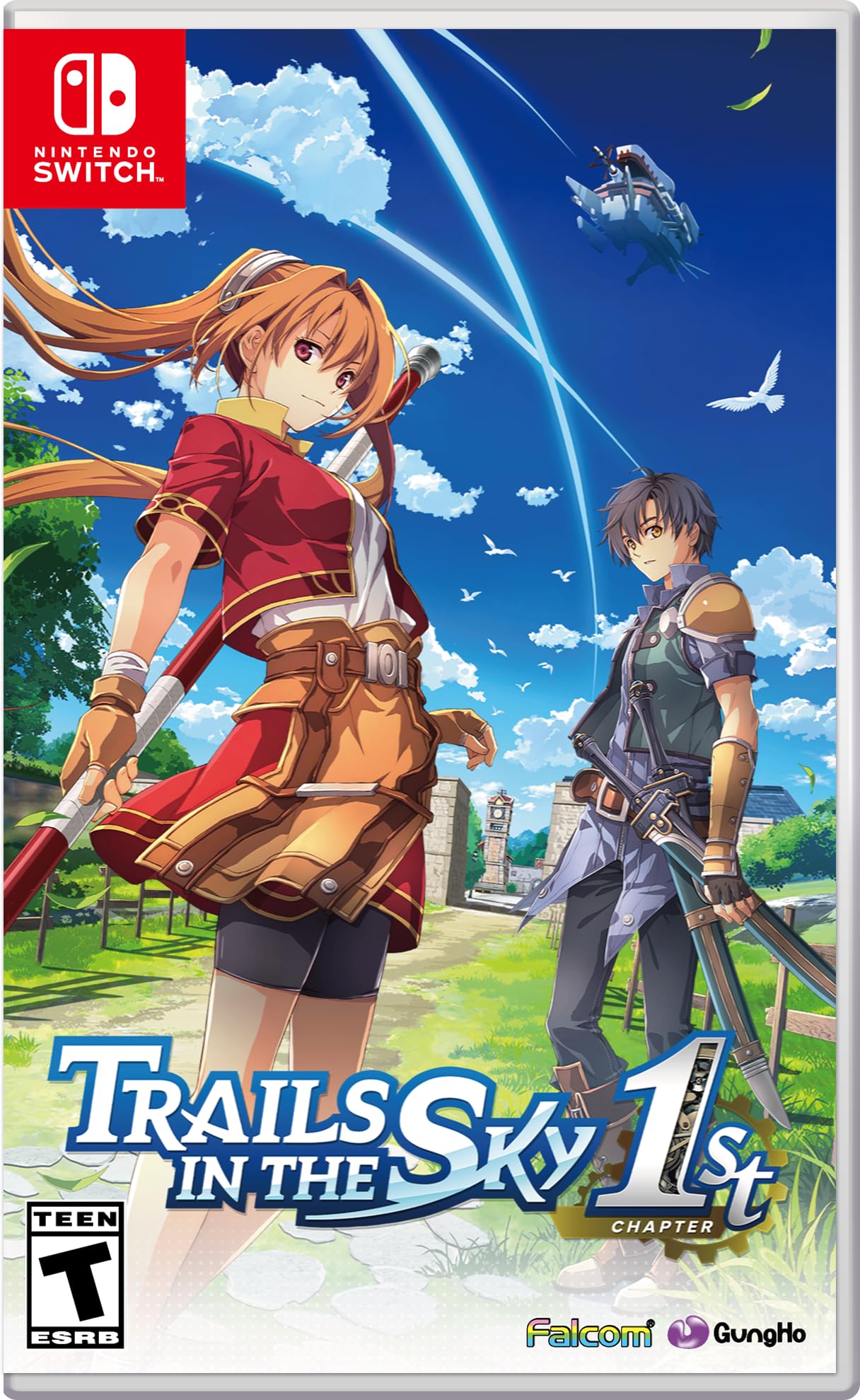
So let's talk gameplay changes - and spoilers here are present, so this will all go beyond the jump:
Trails in the Sky seems to combine multiple gameplay systems from the original and other Trails games, but simplifies them a bit to make them a little easier to handle (and in the case of adding Cold Steel and Daybreak-esque systems, provides no in-plot explanation for why those systems exist, unlike in those games where the systems have a narrative justification). So for example, the game keeps its original arts are derived from orbment line system, which we haven't seen since Trails to Azure (although Trails through Daybreak uses the same system for its shard skills, so it's not entirely gone in modern games). However, the orbment requirements for each particular Art are decreased - so for example, Volcanic Rave cost 8 Fire, 4 Earth, and 2 Space in the original but only 5 Fire, 3 earth, and 5 Mirage in this remake. In fact, no arts in this remake cost more than 5 of a single element, and the game also adds multiple new shields-based quartz (plus a few different new quartz) that provide significant elemental values to make it easier to hit these values. The result is that it is possible in this game to have a single character - most easily Olivier - have every single arts at once, which is necessary for an in game reward and achievement, and more practically, also means that there will almost never be any Arts that you will not naturally have available at some point during the game just by happenstance. There's still some planning required if you want to get specific more powerful arts (Volcanic Rave for instance), but characters pack enough varieties of arts just naturally if you're not using your quartz really really suboptimally such that you're almost never going to feel too big of a dropoff if you switch out one character's old quartz for a newer better one that has a different combination of elements.
The good part about this mind you is that Falcom has done an excellent job at re-balancing the Arts to some extent. While there are new quartz and some old quartz have been replaced due to not making sense in the new system (Cloak is gone and replaced by Hidden Leaf, Eagle Eye is gone entirely, etc.), the game keeps the names of all of the old Arts from FC and in many cases tries to keep those arts similar to the original. The game also adds in the attack powers of every art and craft, so unlike the original the player is fully aware of which Art does more damage before any weaknesses are applied, which is very helpful. Notably, the game tries to eliminate one peculiar element of the original game's attack arts, where more expensive arts sometimes were less powerful or not cost effective to use - so Titanic Roar was the only full screen attack art, but it was super weak in the original: here's it's S powered, meaning it's the most powerful Earth art. So other than some higher tier arts being more expensive in terms of EP, there are rarely reasons to use lower tier attack arts of the same element barring some status effect secondary effects or a sepith up turn bonus (so for example, I used Stone Impact a lot for sepith up turn bonuses since it seemed to feature the most hits and it also was useful to ratchet up stun slightly more than Titanic Roar). But the result of all these changes is that generally speaking, I think I used every single attack art at some point during my run, something that was not the case in the original game (where Fire Arts were often hard to come by on casters and thus were never used). Mind you, certain attack arts are less good than in the original game - the removal of the Faint status effect for instance makes time arts significantly less useful since being non-elemental and not having a chance to incapacitate an enemy more really than other arts (which may also have heavy stun) removes a lot of their value. Similarly, they expanded the range of many originally single target arts - e.g. Flame Arrow is now a line attack instead of single target - which also made some originally extremely used arts like Aerial less unique or worth using here since they were no longer the only arts you could easily acquire that would hit multiple targets.
Support Arts are a different story as they are largely massively changed. In keeping in line with accessories (more on that later), the game seems unwilling to just have each single support art just to one simple thing, and as a result some are massively more useful than others. So for example, Clock Up EX now not only boosts a characters' speed two stages (30%) but also accelerates that character to the top of the turn order. This at worst makes the spell free in terms of time to cast upon one's self and at best allows for turn order manipulation that is super super easy - By the end of the game I made sure to have it on all of my characters because it was just so overpowered, especially since Speed is itself still the most overpowered stat. Sylphen Wing was a useless single target spell that increased a characters' move distance in the original, but in this case it's a spell that hits all player allies, adds "foresight" (Insight from the later games) and boosts one's arts power by one stage (15%) - oh and it also is cast super quickly. This is ridiculously powerful and a must cast at the beginning of every boss battle as it makes your characters dodge nearly everything and increases the power of their arts for 5 turns. Earth Guard now works like the Daybreak shields and hits a decent area at once (wheras in the original it was single target) so now it provides 1K extra bonus shield HP to generally all your characters, which makes it insanely useful in the first few chapters. Earth Wall remains the same as in the original which makes it still very useful...but its useful is tempered by enemy counterattacks being so frequent that you're almost never going to be able to keep an Earth Wall Shield up at all times, so it's now no longer game breaking. By contrast Forte (now also adds CP Regen) and Crest (now adds HP Regen) and Saint (now 15% instead of 25%) cannot compare since them remaining single target (I assume until La Forte and La Crest come next game) makes them too slow to be of use compared to similar promoting abilities. Healing spells also now are not healing fixed values like in the original but amounts based upon a characters' ATS stat and other factors, but are also much less useful simply because of how easily you can now shield and overpower enemies....in the original game I made sure to have healing abilities on everyone and La Teara was critical for when earth wall went down; in this game, there were times I didn't have a healing spell on anyone.
The game adds a bunch of new mechanics from the other games, like I mentioned. From Trails of Cold Steel, the game adds break (stun) gauges, and the three types of brave attacks upon criticals and stuns, as well as support abilities each character learns that are similar to the bonding abilities characters' learned in Cold Steel. In the Cold Steel games, these things were tethered to the bonding system, where pairs of characters formed bigger relationships with each other and thus grew stronger, but that's all non-existent here: brave follow up and rush attacks simply use the next-in-turn character, support abilities trigger seemingly at random and can assist any other character (except when a character is in the new random and pretty superfluous overdrive mechanic, in which case they always trigger). The result is that these mechanics are just sort of there to allow you to do extra damage at times and might affect your character choice in the final dungeon (do I want Olivier with both craft boost and arts boost? Or do I want Kloe despite her not having craft boost?) but otherwise are just sort of there to boost individual characters at times. The game adds in chapter 3 a "Combo Attack" field attack that uses brave points to I guess give this more tactical depth, but I found that attack kind of pointless since the animation slowed things down - I used it 100 times to help trigger some rewards, and then forgot about it (especially as it requires you to be using Estelle or Joshua as your field character). Overall the Cold Steel additions are fine but unremarkable.
By contrast, the game brings in a whole bunch of new things from Trails Through Daybreak that have a lot more impact. Obviously the biggest addition is the addition of real time field combat, although notably the game does not include quick arts from Trails through Daybreak 2 and the enemies never seem as dangerous as they did at times in field combat in that game (I remember in the first Daybreak game early on I was getting pummeled and occasionally knocked into enemy advantage situations before I figured out the system; here, that basically never happened). The cooking system also sort of combines all the games' cooking systems, so we have two (sometimes more) types of meals that can be cooked from each recipe, and cooking a recipe for the first time ala Daybreak gives passive stat buffs to every character. We also have the turn bonuses working like in Daybreak, only instead of those bonuses being stolen only with the assistance of a shard skill or killing enemies, many many skills can steal those turn bonuses, including s-crafts, so it's very rare that an enemy will get a turn bonus that makes you screwed if you're not asleep at the wheel.
Really the biggest issue I had with the Daybreak-esque systems was one that was not related to the combat, but was related to the game's maps. In Daybreak, every map had it so that every building's interior was pre-loaded, so there were no loading screens between areas in towns and/or other dungeons. This made it easy to go talk to everyone in a town, as you could see every person who you hadn't talked to yet on each map in a yellow icon on your map/minimap (they turned grey after being talked to) and easily go up to them to talk to them. Here, the yellow/grey dot icon designation of who there has fresh dialogue returns (although it usually requires you talking to each person twice to get the icon to change annoyingly) but the game doesn't choose to load each building's interior as part of the larger map, and you have to endure loading to get into each building's interior and to discover who might be available to talk to there. Instead, the game loads not only the entire city of each region all at once (even if those cities were previously split into multiple loading zones) but also the roads leading to those cities as well as some of the connected dungeons (but not all - Mistwald is loaded, but Nebel Valley isn't for example). To me, this is a double negative: first it makes the towns and roads look small by connecting them all on the same map, whereas previously Grancel FELT bigger because it covered four separate maps. Second, it also makes it a pain to talk to everyone in a town after the dialogue refreshes because you have to endure lots of loading zones just to find out if there are people to talk to. And in a game where there is so much to find out from talking to everyone, this is very annoying, so I basically stopped trying after Bose to talk to everyone (Admittedly I had done so before in the original game but still).
Finally, I want to touch on a few misc. other things: Crafts, Accessories, and Difficulty. For the most part, all of the characters' crafts are the same as in the original with a few modifications - some crafts have side/back extra damage, Estelle and Joshua lose the Taunt ability (which is now only in Zin's skillset), Kloe and Tita each get one completely new craft, and Zin and Agate's original S-Crafts are demoted to regular crafts. These generally work fine, although at times it feels like a loss of what made some of these abilities special: for example, Zin's two s-crafts in the original were cool because it made it a fun special reveal when he debuted his second s-craft Aural Blast in the tournament. Similarly, Kloe's Kampfer ability was a major ability in the original, with Sieg knocking enemies down in strength and defense being a fundamental part of that game. Here, because of the fact that stat reductions are a percentage chance, Kampfer is basically useless (and now it's a line attack for some reason). Also for some reason Kampfer is a physical attack still (same as in original) but Sturm, which in the original was a few sword thrusts that impeded arts or charged attacks, is now a magical attack that can freeze, which suddenly in the hands of the magic based Kloe makes it super powerful.
Accessories are a big change here actually which is underrated and a major part of why this game gets not nearly as difficult as the original. In the original game, your accessories were very very simple: They generally did one thing and just one thing - so the skull pendent protected just against deathblow, the gladiator headband increased your CP regen, etc. This made the accessories extremely important at times - some gave small stat boosts, some gave your characters elemental attacks (the elemental talismans disappointingly are gone from this game) - but also limited...you weren't getting major stat boosts from your accessories such that it would drastically affect how powerful a character is, and when there were a few accessories that DID do that - in Trails SC, there were the Tiger heart and Crimson Eye - they tended to have severe drawbacks to punish the player for using them. Players had to weigh which accessories' effects they wanted to use against the others, so should I have a gladiator belt or should I have something that boosts speed a small amount? Here, every accessory has multiple effects, some of which are pretty major: so the skull pendent now boosts HP by 1000 (a lot) and by 2000 if you upgrade it. The Feather Brooch upgrades speed, the best stat in the game, as do many many other accessories, including both the Tiger Heart and Crimson Eye, which have no drawbacks whatsoever. As a result, the accessories can have some major major effects and they also have so many effects that there never feels like a tradeoff - the gladiator belt for example when upgraded now comes with a +20 Speed stat boost, which is almost as big as anything else. This gets combined with the fact that the enemies' speed in this game is not nearly as high as it is for enemies in later Trails games, which makes it so that well...you can outspeed even the final boss on nightmare, such that the final boss will not nearly get that many turns as your characters will (especially with Clock up EX cast on everyone - and this is not even counting the obvious infinite turns' trick you can pull off with Schera's Heaven's Kiss and Clock up EX if you want to).
And well I think I'll end there. I have a lot of other individual thoughts, but this has gone way too long already, so let's end it here - loved this game, still had some issues and thoughts on how it was all integrated, and honestly, I do miss the simplicity of the original Trails in the Sky game quite a bit. It may not be considered "modern" to be so simple, but it led to a really well balanced (Earth Wall aside) video game that was challenging and fun to play and while the new gameplay is addictive, it doesn't quite nail that difficulty like the game I remember.
Update: I couldn't resist and played through the game a second time on the game's New Game Plus - Enemy Levels Boosted 50 Levels (and on Nightmare) mode. This is sort of like what the series first included in the endgame of Trails Into Reverie, where in that game in the endgame you could increase the difficulty by boosting enemy levels up to 100 levels, thus increasing all of those enemies' stats and making them more difficult to defeat (but also allowing you to gain levels far more quickly since experience was based upon enemy levels relative to yours). Here, this setting allows you to playthrough the game again with all the equipment and levels and whatever you had at the end of the game but also to boost the enemies so that they had enough HP and stats to seemingly still handle you from beginning to end (It also nicely alters some chests so that all tear balms, thelas balms, and EP Charges are the highest level item of those types and increases the number of U Material items in each chest).
The result is well, really interesting and at times very fun and challenging, allowing me some extra thrill even as I tried to be a completionist and achieve every reward objective and achievement (on my first playthrough, I missed All Quartz, since that required lots of U Materials, all treasure chests, and killing 600 enemies in quick battles - ugh to that last). Rolent and Bose really don't add much challenge simply because while those enemies are now tougher - Josette in Mistwald for example now has similar stats to the final boss - and have stats that might match up with my characters, they don't have the abilities to handle the additional crafts and arts that I now have on New Game Plus. As a result, even if those enemies have HP and stat upgrades to in theory be able to handle my buffed up characters, they don't have the abilities. And even the "in theory" is doing a lot of work there, as by the end of my original NG playthrough my characters' stats were well over what end game level enemies could handle - in particular, I outsped every enemy in the game, and that continued through Bose here (and my main characters' speed stat increased slowly here as I continued to level).
By Ruan though, things change, starting with the Ravens fight, which is genuinely tricky because Kloe joins you in that fight with her original new game equipment....which was fine for taking on the original Ravens but is massively underwhelming for facing the Ravens who are 50 levels higher, meaning Kloe in that fight is way too slow, weak, and equipped (with a bad spell selection) to be of any use for anything other than her S-Craft. Meanwhile the Ravens, as well as other Ruan enemies, suddenly pack enough punch to do serious damage, such that their No Mercy instant kill attack can actually kill a character even with deathblow protection. I actually lost my first attempt at that fight, which required me to more carefully aim Estelle and Joshua's attacks to ensure the 3 main Ravens didn't go into rage all at once and then get a turn to attack thereafter (I was just barely able to stun them all at just the right time so as to ensure they couldn't pull it off a second time). Then the Lighthouse Black Clad Soldiers fight features enemies who can outspeed you for the first time (prior to clock up ex) and who can do serious damage - in fact, on a critical counterattack one of them one shotted Kloe, and on their first turns before I got Sylphen Wings up they one shot Estelle. At this point a lot of the classic strategies from the original playthrough require serious supplements: for example, the easy strategy in most of those fights is to use Sylphen Wings to make your characters' dodge everything and just tank annoyingly counters and rage bursts....but here counter attacks are strong enough to actually kill at times and rage bursts, oh boy. I started targeting the black clad soldiers here, as well as Fango/Bronco, individually to prevent multiple rage bursts at once....it was slower, but necessary to survive - especially as Enemy defense and HP values rose faster than my ability to do damage...the end result was that I was roughly still doing the same amount per attack by the end of the game as I was in NG, except that enemies had significantly more health....which also meant that the bosses could rage burst more frequently and more dangerously.
As I mentioned, by Ruan I had to play significantly more carefully to get rewarded with victory and by the tournament in Grancel, it could be especially nerveracking if I made a misstep....such as miscalculating whether something would kill Kurt, having him resurrect Annelace, and having Annelace immediately rage burst to start wreaking havoc. Oops! I mentioned above that I rarely used healing spells in my original playthough - well, I definitely needed to use La Teara a bunch here. At a certain point in Grancel I started using Earth Wall frequently, eventually converting Estelle into a full time caster of it and other support spells, not to take regular attacks but to allow my characters' to attack without being counterattacked by the enemies' teammates for massive damage (oof)....and to hope that Earth Wall (Earth Guard at this point was patently useless) would allow me to survive the 2 turns of a boss' rage burst. This all culminated with a far more dangerous Lorence fight - still easier than in the original game, but one in which my strategy required the use of careful Earth Wall applications to ensure that Lorence's rage bursts or his s-craft didn't randomly kill me...and he came close. Much more satisfying than the fight I had on my original playthrough. And then the Final Boss' second stage was also far more satisfying, particularly when he entered Carnage Burst at 1/3 HP. In the original playthrough I had, Carnage Burst was more funny than anything - he hit it around 100K HP and I could quickly kill him before he could exploit it to do damage. Here, he entered it with 300K HP left, which meant I had to hold on against an opponent who could no longer miss for far longer....oh and his minions all had over 200K each so that added significantly to the danger. Add in the fact that all of these enemies were now far faster and suddenly able to keep up or exceed me in speed if I didn't (or sometimes did) have my speed buffs on, and these fights became harrowing and extremely satisfying. All of this was fair and I suspect there are multiple strategies one could use to win these battles - I saw one youtube Lvl 95 Lorence fight where the player stacked HP quartz and equipment and fought Lorence straight out and another one which used the obvious Schera infinite (see above). And of course while there are no new equipment to buff your characters further, you certainly could now grind for money and then use to it to buy the (NG+ exclusive) elixers to boost character stats further. There were very few fights and moments that I lost and had to retry - The Ravens are the only one I can think of offhand, but I think it happened like once or twice elsewise on less notable fights - but if I wasn't thinking carefully on how to prepare for fights, I probably would've faced defeat a lot more. It was a highly, highly satisfying playthrough.
The result is well, really interesting and at times very fun and challenging, allowing me some extra thrill even as I tried to be a completionist and achieve every reward objective and achievement (on my first playthrough, I missed All Quartz, since that required lots of U Materials, all treasure chests, and killing 600 enemies in quick battles - ugh to that last). Rolent and Bose really don't add much challenge simply because while those enemies are now tougher - Josette in Mistwald for example now has similar stats to the final boss - and have stats that might match up with my characters, they don't have the abilities to handle the additional crafts and arts that I now have on New Game Plus. As a result, even if those enemies have HP and stat upgrades to in theory be able to handle my buffed up characters, they don't have the abilities. And even the "in theory" is doing a lot of work there, as by the end of my original NG playthrough my characters' stats were well over what end game level enemies could handle - in particular, I outsped every enemy in the game, and that continued through Bose here (and my main characters' speed stat increased slowly here as I continued to level).
By Ruan though, things change, starting with the Ravens fight, which is genuinely tricky because Kloe joins you in that fight with her original new game equipment....which was fine for taking on the original Ravens but is massively underwhelming for facing the Ravens who are 50 levels higher, meaning Kloe in that fight is way too slow, weak, and equipped (with a bad spell selection) to be of any use for anything other than her S-Craft. Meanwhile the Ravens, as well as other Ruan enemies, suddenly pack enough punch to do serious damage, such that their No Mercy instant kill attack can actually kill a character even with deathblow protection. I actually lost my first attempt at that fight, which required me to more carefully aim Estelle and Joshua's attacks to ensure the 3 main Ravens didn't go into rage all at once and then get a turn to attack thereafter (I was just barely able to stun them all at just the right time so as to ensure they couldn't pull it off a second time). Then the Lighthouse Black Clad Soldiers fight features enemies who can outspeed you for the first time (prior to clock up ex) and who can do serious damage - in fact, on a critical counterattack one of them one shotted Kloe, and on their first turns before I got Sylphen Wings up they one shot Estelle. At this point a lot of the classic strategies from the original playthrough require serious supplements: for example, the easy strategy in most of those fights is to use Sylphen Wings to make your characters' dodge everything and just tank annoyingly counters and rage bursts....but here counter attacks are strong enough to actually kill at times and rage bursts, oh boy. I started targeting the black clad soldiers here, as well as Fango/Bronco, individually to prevent multiple rage bursts at once....it was slower, but necessary to survive - especially as Enemy defense and HP values rose faster than my ability to do damage...the end result was that I was roughly still doing the same amount per attack by the end of the game as I was in NG, except that enemies had significantly more health....which also meant that the bosses could rage burst more frequently and more dangerously.
As I mentioned, by Ruan I had to play significantly more carefully to get rewarded with victory and by the tournament in Grancel, it could be especially nerveracking if I made a misstep....such as miscalculating whether something would kill Kurt, having him resurrect Annelace, and having Annelace immediately rage burst to start wreaking havoc. Oops! I mentioned above that I rarely used healing spells in my original playthough - well, I definitely needed to use La Teara a bunch here. At a certain point in Grancel I started using Earth Wall frequently, eventually converting Estelle into a full time caster of it and other support spells, not to take regular attacks but to allow my characters' to attack without being counterattacked by the enemies' teammates for massive damage (oof)....and to hope that Earth Wall (Earth Guard at this point was patently useless) would allow me to survive the 2 turns of a boss' rage burst. This all culminated with a far more dangerous Lorence fight - still easier than in the original game, but one in which my strategy required the use of careful Earth Wall applications to ensure that Lorence's rage bursts or his s-craft didn't randomly kill me...and he came close. Much more satisfying than the fight I had on my original playthrough. And then the Final Boss' second stage was also far more satisfying, particularly when he entered Carnage Burst at 1/3 HP. In the original playthrough I had, Carnage Burst was more funny than anything - he hit it around 100K HP and I could quickly kill him before he could exploit it to do damage. Here, he entered it with 300K HP left, which meant I had to hold on against an opponent who could no longer miss for far longer....oh and his minions all had over 200K each so that added significantly to the danger. Add in the fact that all of these enemies were now far faster and suddenly able to keep up or exceed me in speed if I didn't (or sometimes did) have my speed buffs on, and these fights became harrowing and extremely satisfying. All of this was fair and I suspect there are multiple strategies one could use to win these battles - I saw one youtube Lvl 95 Lorence fight where the player stacked HP quartz and equipment and fought Lorence straight out and another one which used the obvious Schera infinite (see above). And of course while there are no new equipment to buff your characters further, you certainly could now grind for money and then use to it to buy the (NG+ exclusive) elixers to boost character stats further. There were very few fights and moments that I lost and had to retry - The Ravens are the only one I can think of offhand, but I think it happened like once or twice elsewise on less notable fights - but if I wasn't thinking carefully on how to prepare for fights, I probably would've faced defeat a lot more. It was a highly, highly satisfying playthrough.
So yeah, Trails in the Sky's gameplay remains addictive and incredibly fun, even with my preference perhaps for the simplicity of the original this game is just an utterly terrific remake that I wish would get more attention.

No comments:
Post a Comment