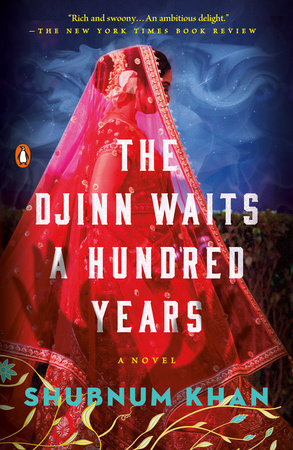
The Djinn Waits a Hundred Years is a gothic novel by South African author Shubnum Khan. The story follows a girl, Sana, whose father takes her to live in what used to be a mansion, but is now a dilapidated house haunted by the past. The novel is more like magical realism than fantastical (or a horror) with the titular djinn being mostly just an observer who maintains the strong atmosphere of sadness and Sana's haunting being something that might not even be real. The book manages to set an incredible atmosphere, both as it tells a story in the present - with the house occupied by a bunch of older Indian Muslim residents all with various forms of heartbreak/trauma - and the past, as the story reveals what happened in the house that has haunted it all this time.
It's a story that is at times heartwrenching and sad but is ultimately hopeful, as Sana reads about the love and tragedy of the past and sees the heartbroken hearts of her neighbors and yet manages in the end to be captivated by the love she's read and finds some way forward. I'm not usually a person who loves reading bits that are based upon description to set atmosphere, but this one really worked, and the characters in both timelines work really well, as does the love between them and the traumas that many characters struggle with. The result is a really good novel that I would definitely recommend.
Plot Summary:
Since her mother died, Sana's father has taken her from place to place, seemingly in search of a home by the shore. Now he has taken her to Akbar Manzil, what was once a large and ecccentric estate on the coast of South Africa, but now has fallen into disrepair and turned into a tenement house for a bunch of older residents. Sana has no idea why this is the place her father has taken her to, or how she is supposed to connect with a group of odd older Indian and Muslim residents who all seem haunted by their own individual heartbreaks and tragedies. But as she searches the house and soaks up the others' stories, she senses somehow that the house itself is alive and haunted...for unbeknownst to her a Djinn lives inside the house's walls, miserable and sad.
But when Sana discovers a room long locked in one of the house's wings, she discovers the past that the Djinn and the Haunted House have long kept hidden. Soon she becomes enraptured in the story of the eccentric rich man from India who came to South Africa with his proud wife...and of the love that blossomed between him and a common worker. It's a story that doesn't have a pleasant end and has haunted Akbar Manzil for a century...and yet the love Sana reads about may be just the thing she needs to break free of her own past of tragedy and trauma.....
The Djinn Waits a Hundred Years is a hard book to describe because - while the flashbacks are clearly heading towards tragedy - it's hard to see where the book is actually going for a long time. The story starts following just Sana but after the first act begins frequent flashbacks to the time a hundred years before when wealthy Muslim Indian immigrant Akbar Ali Khan brings his family to South Africa and builds the Akbar Manzil estate they now live in, with occasional bits from the perspective of a djinn who is really just an observer in a bit of magical realism. There's also often a question of where the flashbacks are coming from - Sana finds a journal belonging to a character from the flashbacks, but it's clear that what the reader finds out through the flashbacks is not actually what Sana is reading about and that the reader is finding out far more information than Sana is obtaining.
And yet, the story captivates quite easily as it explores both the gothic nature of an Estate that is afraid of a girl like Sana probing into its tragic secrets, the natures of the generally sad current residents of the estate - a group of older Muslim residents all with skeletons in their closet that makes them struggle to get along and to not be miserable - and reveals what happened in the past. The story does a great job establishing the creepy and tragic atmosphere of the house, a necessity in a gothic story but also something that I often don't really value compared to characters. But the characters here are so phenomenal in filling out the setting, the story's themes, and just in and of themselves.
They combine to tell a story about dealing with one's tragic past and about recognizing the possible love in the future and finding a path forwards. Take Sana, our main character for example: she struggles immensely with the fact that her mother didn't seem to love her, her father keeps transplanting her places, and she finds herself haunted by the ghost of her once conjoined sister, who constantly urges her to die. But she's also immensely curious and optimistic about there being some kind of "love" out there that is romantic and worth seeking, a person in the future who one can join with to become two people as one. And so she goes searching throughout the house for ideas about that love, talking to everyone and investigating the past. Really the only thing that stops her is being seemingly cut off from discovering more about the past...because it's not the tragedy that shakes off the curiosity of her that keeps her sane, but it's the cutting off of answers. And in the end, she finds a possibility of love, especially as she sees the tragic ending of the past but also sees how her revealing of the story can give answers to someone in the future.
I'm kind of explaining this poorly - not helped by me reading this book at the start of my vacation and writing this review afterwards (sorry). But we see it again and again in the characters we meet, from the women and men in modern day Akbar Manzil who deal with various forms of heartbreak, to Sana's father who is surprisingly NOT traumatized and instead finds enjoyment in cooking in the wake of his beloved's death, to the story of Meena, a common laborer in the past who is unwillingly married to the estate's eccentric rich owner...and yet who comes to love him anyway due to his eccentricities, love of poetry, and more, even as she struggles with his prior wife and his mother who hate her for her lower station. Indeed, her story and Sana's makes clear that love transcends stations in life, and that it can cast a light for hope into the future.
It's all written incredibly well, making it so that even when events are clearly turning tragic and you feel the urge to look away to avoid seeing depressing things come back upon characters you like, you can't turn away. An easy recommend.

After the breakup, there was a deep sense of loss and a strong desire to reconnect. It felt important to explore every possible avenue to bridge the gap that had formed. Dr. Agbazara brought back my lover in just 72hours after i contacted him when some recommended him to me here online, i will only advise those who are having issues in there relationship or marriages to contact Dr.AGBAZARA TEMPLE through these details via email at; ( agbazara@gmail.com ) or WhatsApp him on: ( +2348146274490 ) and get the help you need
ReplyDelete